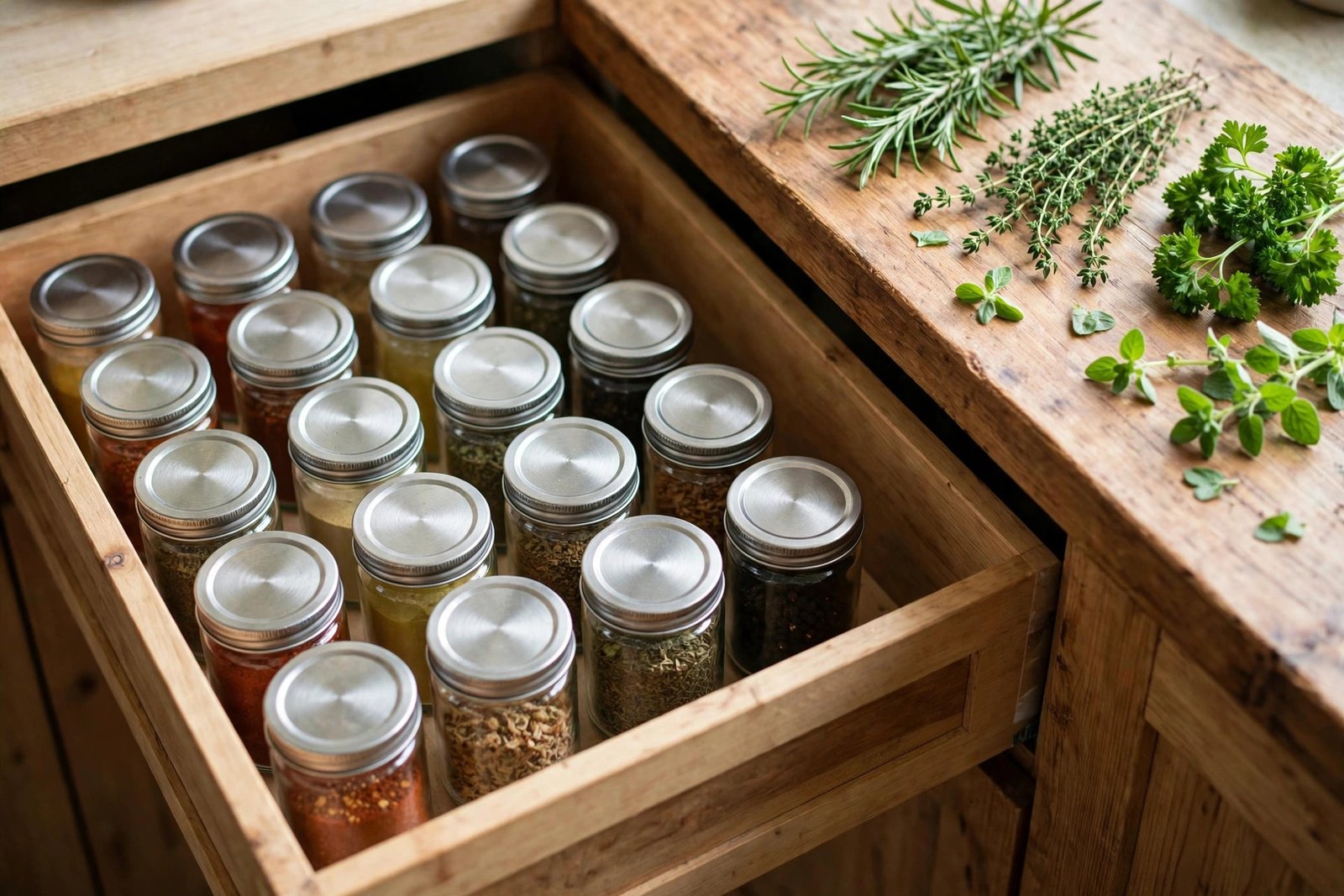
Good spice drawer organisation sounds like a small thing until you are halfway through a recipe, hands covered in flour, hunting for cumin that you know you own. A well-organised drawer means every spice is visible, labelled and within reach, cooking flows without interruption, and you stop buying duplicates of jars that were hiding at the back all along. The best systems are not the prettiest ones on social media. They are the ones that still work on a busy Tuesday.
A drawer is actually one of the best places in the kitchen for spices. It is dark, usually cool, and close to the worktop where you prepare food. Unlike a deep cupboard, a drawer shows you its whole contents from above when you open it, which is exactly what you need when thirty small jars are competing for your attention. This guide walks through choosing jars, picking a layout that suits your drawer, labelling that you can read at a glance, and the habits that keep the system tidy after the first enthusiastic weekend.
You do not need to buy a matched set of everything or own forty spices to benefit. Start with what you have, apply the principles in order, and improve in stages. Organisation is a system, not a shopping trip.
Start by Taking Everything Out and Being Honest
Every successful reorganisation begins with an empty drawer. Take every jar, tin, packet and mysterious unlabelled pot out and put them all on the counter. Wipe the drawer clean, because spice dust and the odd chilli flake migrate everywhere over time. Then sort what you have into three groups: spices you use weekly, spices you use occasionally, and spices that are faded, duplicated or unidentified.
Check freshness as you sort. Open each jar, rub a pinch between your fingers and smell it. Anything that smells of nothing, or smells musty, should go. Our guide to how long do spices last gives you the shelf life ranges and freshness checks to sort with confidence, so you are not organising jars that should have been replaced a year ago. Consolidate duplicates into the fresher jar where sensible, and write a short shopping list for gaps and replacements while everything is visible.
Finally, count what is staying. The number matters because it decides your layout. Twenty jars need a different arrangement from fifty, and being honest about your real collection stops you buying inserts that do not fit or jars you do not need. If you are still building your collection, a versatile core set of everyday spices will fit comfortably in one standard drawer, leaving room to grow slowly as your cooking expands.
Choosing Jars That Work in a Drawer
Uniform jars are the single biggest upgrade for drawer storage. When every jar is the same size and shape, they pack neatly, move predictably and present their labels at the same angle. Mixed collections of tall bottles, squat tins and floppy packets waste space and hide each other, no matter how carefully you arrange them on day one.
What to look for
- One consistent size that fits your drawer depth when lying at an angle or standing, with room for the drawer to close freely.
- Wide enough mouths to fit a teaspoon inside, so you never have to pour spice into your hand over a steaming pan.
- Airtight lids that screw or clip firmly, because a drawer full of loosely capped jars perfumes itself and fades faster.
- Glass or metal that washes cleanly and does not hold on to the smell of the previous spice.
- A flat lid or a flat side, so the label has somewhere readable to live.
Decant packets and bulky shop jars into your uniform jars as you buy them, and keep any surplus in a sealed bag or box in a cool cupboard as a refill store. This two-level system, a tidy working drawer plus a hidden refill stash, is how organised kitchens stay tidy without wasting money. Our article on buying spices in bulk explains how to manage the refill side sensibly so larger purchases stay fresh until they reach the drawer.
Layouts That Actually Work
There are three proven drawer layouts. The right one depends on your drawer size and how many spices you keep, and all three beat a loose jumble.
Angled rows on a tiered insert
A stepped or angled insert holds jars tilted toward you in rows, labels facing up, like seats in a small cinema. This is the most readable layout of all and the best choice if your drawer is deep enough. You can scan the entire collection in one glance without moving a single jar. Inserts are widely available, but a couple of thin wooden strips or even rolled towels at the back of the drawer can create a simple version while you decide.
Flat rows with lid labels
In a shallow drawer, lay jars flat in neat rows or stand them upright if height allows, with the name written on the lid. Reading lids from above is fast once you are used to it, and this layout fits the greatest number of jars in the least space. Keep rows straight with a simple grid insert, a cut-to-size non-slip mat, or small boxes acting as dividers, because flat jars roll and drift every time the drawer opens if nothing holds them.
Zones within the drawer
However you arrange the jars physically, group them into zones that match how you cook. One workable scheme keeps everyday spices at the front, baking spices together, whole spices together, and blends together. Another cook might group by cuisine, with Indian, Mexican and Mediterranean favourites in their own clusters. Alphabetical order is the classic alternative and suits very large collections and households where several people cook, because anyone can find and replace a jar without learning a personal system. Choose the scheme that matches your habits, not the one that photographs best, and give it a full month before judging it.
Whichever layout you pick, leave a little breathing room. A drawer packed so tightly that jars must be levered out will be a mess within weeks, because putting things back becomes a chore. Eighty percent full is a good target, with the remaining space absorbing a new purchase or a seasonal blend without a reshuffle.
Labelling You Can Read at a Glance
A drawer system stands or falls on its labels. Every jar needs its name where your eye naturally lands, which in a drawer means the lid or the upper face of the jar, not a label on the side that faces its neighbour. Write or print the name in large, plain lettering you can read in ordinary kitchen light without picking the jar up. Consistency helps more than decoration: same style, same position, same pen.
Add the date you filled the jar, either on the same label in smaller writing or on a small sticker underneath. Dates turn freshness from guesswork into a glance, and they make your twice-yearly spice review almost automatic. Our dedicated article on labelling and dating spices covers simple label methods, including what to do with homemade blends so you remember both the contents and the mixing date.
For blends, go one step further and note the character on the label, such as mild curry powder or hot Cajun, salted. When you own two versions of anything, and keen cooks often do, that one extra word prevents the mid-recipe mistake that ruins a dish. Colour coding can help too, with one lid colour for sweet baking spices and another for hot blends, as long as the written name remains the primary identifier.
Keeping the System Working Week After Week
The honest truth about organisation is that the setup is the easy part. Systems fail through small daily habits, so build the maintenance into the system itself. Put every jar back in its spot immediately after use, even mid-recipe, by keeping a clear patch of worktop for the jars in play and returning them as a group when the dish no longer needs them. Wipe jar rims and lids when they get dusty or sticky, because a cook is far more likely to maintain a drawer that feels clean.
Refill from your backup store in one short session rather than jar by jar, and wash and fully dry a jar before refilling it with a fresh batch. Never top fresh spice onto stale remnants, and update the date label every time you refill. When you buy a genuinely new spice, give it a home immediately: decide its zone, label it, and if the drawer is full, let it displace your least-used jar to the cupboard rather than squeezing everything tighter.
Storage quality matters as much as orderliness. A drawer is naturally dark, which protects flavour well, but keep it away from being directly beside or under a hot oven if your kitchen layout gives you a choice, and never let it become a dumping ground for batteries, string and takeaway menus. Our full guide on how to store spices explains the heat, light, air and moisture rules that a good drawer already mostly satisfies, and is worth reading alongside your new layout. Twice a year, repeat the empty-and-check routine in miniature: it takes fifteen minutes once the system exists, and it keeps the drawer honest.
Common Problems and Simple Fixes
A few problems come up in almost every spice drawer, and all of them have cheap fixes. Jars rolling or sliding usually means the drawer needs a non-slip liner or dividers, not new jars. Running out of room usually means duplicates, faded jars and rarely used packets are taking working space, so a clear-out and a refill box in the cupboard solve it. Family members putting jars back in random places usually means the system is too personal or the labels are too small, so switch to alphabetical order and bigger lid labels. Spice dust everywhere usually means lids are not being closed fully or jars are overfilled, so leave a small gap at the top of each jar and make closing lids part of the cooking flow. None of these fixes requires spending much; all of them require noticing the friction and removing it.
Conclusion
Spice drawer organisation that actually works rests on a few unglamorous choices: clear out and check freshness first, decant into uniform airtight jars, pick an angled, flat or zoned layout that fits your drawer and your cooking, label lids clearly with names and dates, and maintain the system with quick returns, honest refills and a short review twice a year. Do those things and your drawer becomes what it should be, a quiet tool that puts the right spice in your hand in seconds and makes everyday cooking noticeably smoother.
Leave a Reply